Brief Introduction
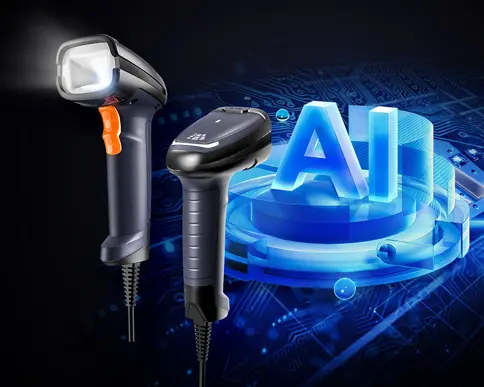
Seuic HS305DP barcode scanner addresses the challenge of recognizing barcodes on reflective metal surfaces by using AI scanning technology. It can identify barcodes without needing a specific angle, providing businesses with efficient and convenient barcode recognition.
Background:
In today's highly automated manufacturing environment, barcode technology has become an indispensable part of the production process. Especially in the metal manufacturing industry, barcode identification runs through the entire industrial chain, from raw material management and production process tracking to finished product outbound. However, the highly reflective surface characteristic unique to metal materials has long been a bottleneck restricting the application of barcode identification technology.
1. Barcode Identification Challenges Faced by Metal Manufacturing Enterprises
1) Severe Test of Environmental Reflection Interference
Metal manufacturing workshops usually have strong ambient light interference, including natural light, direct light from industrial lighting equipment, and reflected light from metal equipment surfaces. These complex lighting conditions can cause severe specular reflection on barcode images, making it difficult for traditional scanning equipment to accurately capture barcode information. In practical applications, operators often need to repeatedly adjust the scanning angle to find a suitable position to avoid reflection. This process not only significantly reduces work efficiency but also increases operational difficulty
2) Technical Challenges Posed by Surface Characteristics
Different types of metal materials have their own unique surface characteristics. Common metal materials like stainless steel and aluminum alloy have relatively high surface smoothness and large reflectance coefficients, while materials like cast iron and forged steel have relatively rough surfaces but still produce diffuse reflection phenomena. These surface characteristics impose higher requirements on the print quality of barcodes and their identification effectiveness. Traditional scanning equipment often faces problems such as decoding failure and high misread rates when dealing with these complex surfaces
3) Special Requirements of the Production Environment
Metal manufacturing workshops have complex environments with adverse factors such as oil stains, dust, high temperatures, and vibration. These environmental conditions not only affect the durability and readability of barcodes but also pose severe challenges to the stability and reliability of scanning equipment. Furthermore, the high-speed operation of production lines requires scanning equipment to have fast response capabilities; any identification delay may lead to production interruptions or quality incidents
4) Analysis of Limitations of Existing Technologies
Traditional laser scanners and image-based scanners have obvious shortcomings when dealing with barcode identification on metal surfaces. Laser scanners have stringent requirements for scanning angles and need precise alignment with the barcode to complete reading; whereas ordinary image-based scanners are prone to overexposure in highly reflective environments, leading to loss of barcode information. These technical limitations seriously restrict the digital transformation process of metal manufacturing enterprises
To tackle this issue, a large metal manufacturing enterprise introduced Seuic HS305DP barcode scanner.
To tackle this issue, a large metal manufacturing enterprise introduced Seuic HS305DP barcode scanner.
2. Technological Breakthrough of the SEUIC HS305DP Barcode Scanner
1)Strong Image Recognition Capability of Seuic HS305DP Barcode ScannerSeuic HS305DP barcode scanner utilizes advanced AI image processing and recognition algorithms, which can automatically adjust the scanning angle and light intensity to accommodate metal barcodes under different reflective conditions. Even in cases of strong barcode reflection, Seuic HS305DP can quickly and accurately capture barcode information, achieving efficient recognition.
2)Fast Scanning Speed of Seuic HS305DP Barcode Scanner
Traditional barcode scanners often need to be positioned at specific angles to read barcodes successfully, whereas Seuic HS305DP barcode scanner maintains stable recognition performance from multiple angles. This allows operators to adjust the scanner's position and angle more flexibly without repeated attempts and adjustments, greatly improving work efficiency.
3)User-Friendly Design of Seuic HS305DP Barcode Scanner
Features such as a comfortable grip, an intuitive display screen, and a user-friendly interface make it easier and more convenient for operators to use the device. Additionally, Seuic scanner supports multiple interface options, including USB and Bluetooth, allowing seamless connection with various devices for quick data transfer and sharing.
For years, SEUIC has focused on the research and development of products such as handheld PDAs,RFID readers, fixed scanners, and industrial barcode scanners. Leveraging extensive design experience in the industrial-grade 4G/5G terminal field and relying on highly reliable product capabilities and efficient services, our products have been widely used in manufacturing, retail e-commerce, logistics and express delivery, healthcare, and public utilities.
- Demystifying Manual Traceability Pains: How CRUISE2 5G Enables Barcode-Based Bidirectional Traceability2026-04-03
- Demystifying Slow Backroom Transfers: How UTouch 2-S Enables Second-Level Inventory Navigation2026-04-03
- Demystifying Quality Control Bottlenecks: How RFID Moves Towards Proactive Prevention2026-04-02
- How Handheld Computers Achieve End-to-End Traceability2026-04-02
- Demystifying Workstation Information Bottlenecks: How CRUISE2 5G Enables Paperless, Real-Time Operations2026-04-01
