Brief Introduction
With the development of the times, the manual note-taking warehousing management model can no longer adapt to modern management requirements, and RFID readers are indispensable in warehousing management. It uses wireless communication technology to interact with item information and cloud databases in real time to achieve real-time monitoring of goods. Precise monitoring and management of management. Next, we will introduce in detail the application of RFID readers in warehouse management and what significant advantages it can bring to our warehouse management.

Challenges in Warehouse Management
Before exploring the application of RFID in warehouse management, let's first examine the current challenges in warehouse management:
1. Information Lag and Lack of Visibility
Traditional warehouse management heavily relies on manual recording and barcode scanning, resulting in significant delays in information updates. Inventory data often takes hours or even a day to synchronize with the management system, leading to the following issues:
● Decision-makers cannot access real-time inventory data, affecting procurement and sales decisions
● Difficult to trace the causes of inventory discrepancies in a timely manner
● Inability to provide accurate information when customers inquire about order status
2. High Dependency on Manual Operations
Many processes in warehouse operations require manual participation, leading to significant problems:
● Picking error rates as high as 3-5%, causing issues such as wrong shipments and missed shipments
● Long training cycles for new employees, high retraining costs due to staff turnover
● Labor shortages during peak periods directly affect order processing capacity
3. Data Silos and System Integration Challenges
Lack of effective integration between warehouse management systems and other business systems:
● Inconsistent data standards among WMS, ERP, TMS and other systems
● Delays and errors in cross-system data synchronization
● Difficulty in achieving transparent management of the entire supply chain
4. Prominent Operational Efficiency Bottlenecks
Traditional operating methods have obvious efficiency bottlenecks:
● Manual inventory counting requires warehouse closure, affecting normal inbound and outbound operations
● Paper document flow leads to low information transmission efficiency
● Insufficient order processing capacity during peak periods, leading to decreased customer satisfaction
5. Difficulties in Operating Cost Control
Hidden costs in warehouse operations are difficult to effectively control:
● Labor costs continue to rise, accounting for an excessively high proportion of total operating costs
● Hidden costs such as cargo damage and wrong shipments caused by operational errors are difficult to quantify
● Low equipment utilization rates, unsatisfactory return on asset investment
6. Lack of Scalability and Flexibility
Existing warehouse systems struggle to adapt to business changes:
● Limited system capacity to handle sudden business volume increases during peak seasons
● Difficult to adjust systems when adding new business types or changing processes
● Lack of a unified platform support for multi-warehouse collaborative management
7. Security Management Concerns
Security risks in the warehouse environment cannot be ignored:
● Anti-theft measures for valuable goods rely on manual monitoring, creating blind spots
● Inadequate monitoring of storage conditions for special goods (such as hazardous chemicals)
● The safety protection measures for operational personnel need to be improved
These issues directly constrain the improvement of warehouse management efficiency and cost optimization. The application of RFID technology provides effective solutions to these pain points. By enabling real-time data collection, automated operations, and intelligent analysis, RFID readers can significantly enhance the precision and operational efficiency of warehouse management.
Application of RFID readers in warehouse management
1. Real-time tracking and monitoring
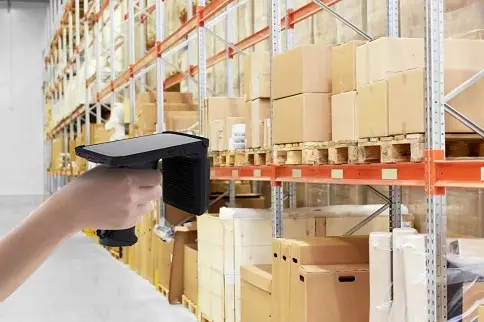
AUTOID UTouch RFID reader can track and monitor the location and operating status of items in real time. By attaching RFID tags to each item and installing RFID readers in the warehouse, warehouse managers can know the storage location and flow trajectory of the items at any time. It improves the accuracy and efficiency of logistics operations and also provides real-time inventory management and exception handling capabilities.
2. Automated warehouse management
The combination of RFID readers and warehouse management systems enables warehouse management to be highly automated. When the AUTOID UTouch RFID reader scans an item, the system will automatically identify its information and perform classification, storage or shipping operations. At the same time, RFID readers can also be combined with other automation equipment to realize automated selection, picking, loading and unloading, etc., greatly improving the efficiency and accuracy of logistics operations.
3. Accurate data analysis and decision support
AUTOID UTouch RFID reader can collect large amounts of logistics data in real time and upload it to a cloud database for analysis and storage. Through data mining and analysis, warehouse managers can gain in-depth understanding of all aspects of the logistics process.- Demystifying Manual Traceability Pains: How CRUISE2 5G Enables Barcode-Based Bidirectional Traceability2026-04-03
- Demystifying Slow Backroom Transfers: How UTouch 2-S Enables Second-Level Inventory Navigation2026-04-03
- Demystifying Quality Control Bottlenecks: How RFID Moves Towards Proactive Prevention2026-04-02
- How Handheld Computers Achieve End-to-End Traceability2026-04-02
- Demystifying Workstation Information Bottlenecks: How CRUISE2 5G Enables Paperless, Real-Time Operations2026-04-01
