Brief Introduction
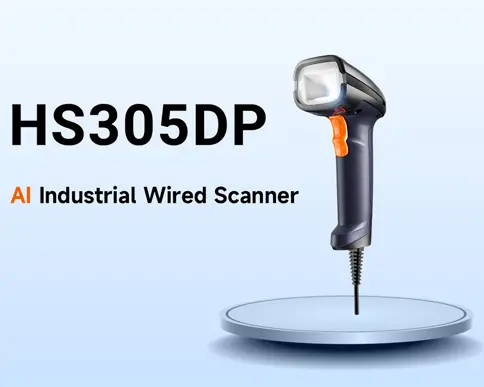
The HS305DP industrial code scanner scans engraved codes on the surface of metal parts, effectively solving barcode contamination caused by rust and oil stains, and uses AI scanning technology to improve barcode recognition accuracy and efficiency.
In the field of industrial manufacturing, barcode recognition is an indispensable part of the production process. However, engraved barcodes on metal part surfaces often face contamination issues such as rust and oil stains due to special processing environments, making it difficult for traditional scanners to read accurately. SEUIC's HS305DP industrial barcode scanner effectively addresses these pain points through AI technology and intelligent design, improving recognition accuracy and efficiency. This article will provide an in-depth analysis of the challenges in scanning barcodes on metal surfaces and detail the exceptional performance of the HS305DP.
1. Analysis of Difficulties in Scanning Engraved Barcodes on Metal Part Surfaces
Engraved barcodes (such as DPM codes) on metal part surfaces are common in industrial applications, but the scanning process faces multiple challenges. These difficulties not only affect production efficiency but may also compromise product quality traceability. The main challenges include:
l Strong Surface Reflectivity: Metal materials are highly reflective, especially on bright or curved surfaces, where barcodes can easily cause glare due to light reflection, making it difficult for scanners to capture clear images. For example, laser-engraved codes on automotive parts may be completely unreadable under strong light.
l Severe Contaminant Coverage: In processing environments, contaminants such as oil stains, rust, and dust easily adhere to the barcode surface. These contaminants can blur the lines or dot matrix of the barcode, reducing contrast, often causing traditional scanners to misread or miss reads. Statistics show that on automotive production lines, over 30% of barcode reading failures are due to oil stain coverage.
l Inherent Barcode Defects: Engraved barcodes may suffer from distortion, blurring, or low contrast due to imperfect processing techniques. For example, dot peen codes on metal surfaces are prone to deformation due to uneven pressure; while laser-engraved codes may develop burn marks from improper energy control, further increasing recognition difficulty.
l Environmental Interference: Temperature and humidity changes in industrial sites can affect the physical state of barcodes, such as thermal expansion and contraction causing micro-deformations. Simultaneously, the high-speed operation of production lines requires scanners to have fast response capabilities, but harsh environments often reduce scanning speed.
l Specific Challenges of DPM Codes: Direct Part Marking (DPM) codes are commonly used on metal parts, but issues like varying perforation depths and engraving depths can damage the quiet zone, increasing decoding complexity.
These challenges not only slow down the production pace but may also lead to data loss, affecting the transparency of the entire supply chain. The design of the HS305DP scanner is born from addressing these challenges.
2. HS305DP Scanner Performance Supplement: Perfect Integration of AI Technology and Intelligent Design
2.1 Advanced AI Algorithms and Dual-Core Processing
The HS305DP is equipped with fourth-generation AI scanning technology and a dual-core processor, enabling real-time analysis of barcode images, automatically identifying and filtering background interference. For example, when faced with blurred or low-contrast barcodes, the AI algorithm can enhance image details through a deep learning model, improving decoding accuracy to over 95%. The dual-core architecture ensures smooth multitasking, maintaining stability even in high-intensity scanning environments.
2.2 High-Precision Sensors and Lighting System
The device is equipped with a 1.3-megapixel CMOS sensor, supporting accurate scanning of 1D, 2D, and high-density barcodes. Particularly noteworthy is its intelligent three-color lighting system (blue, red, white), which can automatically adjust the light source mode based on the barcode's background material. For example, for dark metal surfaces, the system switches to red light to enhance contrast; for reflective areas, it uses blue light to reduce glare. This adaptive lighting effectively handles barcodes covered with oil stains or rust, ensuring a high first-time scan success rate.
2.3 Exceptional DPM Code Decoding Capability
The HS305DP is optimized for DPM codes, capable of handling various complex scenarios, such as dot peen codes on automotive parts, perforated codes on PCB boards, and low-contrast QR codes on graphite materials. Tests show that even with up to 40% barcode wear, the scanner can still achieve accurate reading through AI compensation technology, significantly reducing the rework rate.
2.4 User-Friendly Human-Machine Interaction Design
The scanner top features a three-way read status indicator and a hidden power display, allowing operators to see the device status at a glance. The carbon fiber texture grip design is ergonomic, reducing fatigue during prolonged use. Additionally, the tool-free cable detection function enables plug-and-play, simplifying the deployment process and extending cable life.
The HS305DP industrial barcode scanner comprehensively solves traditional challenges in metal surface barcode recognition through AI-driven technology and intelligent design. Its high performance is reflected not only in fast decoding but also in its resilience to adapt to complex industrial environments. With the advancement of Industry 4.0, such equipment will become a key tool for smart manufacturing, helping enterprises achieve digital upgrades.
As a professional manufacturer of data collection terminal equipment, SEUIC has been focusing on the R&D of handheld PDAs, industrial barcode scanners, RFID readers/writers, fixed-mount scanners, and other products for many years. Leveraging rich design and production experience accumulated in the industrial-grade 4G/5G terminal field, and relying on highly reliable product performance and efficient services, our products have been widely used in manufacturing, retail e-commerce, logistics and express delivery, healthcare, and public utilities.
last
- Demystifying Manual Traceability Pains: How CRUISE2 5G Enables Barcode-Based Bidirectional Traceability2026-04-03
- Demystifying Slow Backroom Transfers: How UTouch 2-S Enables Second-Level Inventory Navigation2026-04-03
- Demystifying Quality Control Bottlenecks: How RFID Moves Towards Proactive Prevention2026-04-02
- How Handheld Computers Achieve End-to-End Traceability2026-04-02
- Demystifying Workstation Information Bottlenecks: How CRUISE2 5G Enables Paperless, Real-Time Operations2026-04-01
